The Art of Living Well: Rehearsing Failure and Symbolic Death for a Successful Life

The Art of Living Well: Rehearsing Failure and Symbolic Death for a Successful Life

One of the best ways to set ourselves to success in any endeavour in life, is prepare ourselves the best for a potential failure. While it is true, with respect to skills, strengths and ability, it is better to strengthen our strengths than bridge the endless gap of lack of it. That does not work in the area of mindset and attitude.

How much ever we reframe ourselves with positive thinking and paper over those fears with hope, fear of failure, performance anxiety lies in some distant corner of our mind, like that potassium permanganate capsule. And the moment it gets burst in a beaker of water, it colours the water in no time. The same with that capsule of fear of failure / performance anxiety in the darkest recesses of our mind.

And only way we can purge it out of our system is, putting the 1000 lumens headlight of awareness right into it. All human transformations begin with awareness. In management parlance, there is a cycle of unconscious incompetence to unconscious competence. Unless we bring out what is there in our unconscious mind to the effervescent light of awareness, we will never be able to transform it.

This is where the ancient practices come alive. The way to do it is those Stoic exercises on death or Jesuit memento mori. While I learnt the Stoic exercise from the annual Stoic Week organised by University of Exeter, Fr. AMA taught me about the Jesuit practice of memento mori. Once we visualise what is the worst that can happen in our endeavour and then survive those torrid feelings in our body, it dissolves itself. The nervous system learns it has already “died” and returned. The capsule loses its potency. This is not just a mental reframing but a physiological release — the body itself learns freedom.

Athletes too have discovered this gate. Sports psychologists train competitors to rehearse failure — missed shots, falls, defeats — so that when the real contest arrives, the body does not recoil. The fear has already been faced. And Phil Jackson, the “Zen Master” of the Chicago Bulls, brought this wisdom to Michael Jordan, Scottie Pippen, and their teammates. He taught them meditation, breath awareness, and detachment from outcomes. In his method, the game was not just about winning but about presence. By rehearsing loss, by facing impermanence, the Bulls dissolved their fear and played with freedom.

I have been a student of spirituality and meditation for some 30+ years. And I did read quite a bit (in fact late Dr. Satish Inamdar, KFI Trustee and Director of The Valley School had said to me once, I will find my “way” when I stopped reading!) and did my quota of channel surfing and spiritual shopping in my life. And the search kind of ended while watching an NBA basketball match on TV in West Haven. Seeds of Zen were planted in my mind in the most unlikely of places. West Haven.

During June 1998. That was my first visit to the land of Baseball and Basketball. Both Greek and Latin games for me as a spectator. In the NBA final, Chicago Bulls were playing against Utah Jazz. What got my eye and attention was Chicago Bulls Coach Phil Jackson. There was an article in NYTimes that he used to make players like Dennis Rodman, who was an out and out rebellious, rule-breaking toughie, and Scottie Pippen and the larger-than-life Michael Jordan, all managed by the Zen Coach, Phil Jackson. I would have read and reread his book Sacred Hoops more than once. He was deeply spiritual with Native Indian and Zen philosophy. In fact, Jackson spent a large part of his life studying Buddhism and its principles, from his mentor Shunryu Suzuki. Jackson wrote, “What appealed to me about Zen practice was its inherent simplicity. It didn’t involve chanting mantras or visualizing complex images, as had other practices I’d tried. Zen is pragmatic, down-to-earth, and open to exploration. It doesn’t require you to subscribe to a certain set of principles or take anything on faith.”

Fourteen years later, in 2012, after my own experiments with truth and lies of spirituality, I did a hard landing into Bodhi Zendo and Zen, and real spiritual seeking started.

AMA Samy and Bodhi Zendo were different. I would compare Bodhi Zendo a bit with Esalen of Big Sur, CA. One of the most beautiful places of learning I had visited. It was not as regimented as a Vipassana session. It did allow a good amount of personal space to oneself. Sometimes a good conversation, a good joke and laughter at the dining table along with some yummy food, is as good as anything else in this world towards one’s spiritual seeking.

Secondly, AMA Samy had one of the best collections of books on spirituality, philosophy, theology and psychology I have seen in my life. (AMA seems to have read most of them.) When I was a full-time student of MA Education at APU Bangalore, I had to write a term paper on Phenomenology of Krishnamurti’s teachings as an assignment for Dr. Kaustav Roy. I was searching for a book of Heidegger at the Zendo library one December afternoon. AMA walked in to keep some book and he asked me what I was reading. When I explained to him my struggle with that phenomenology paper, he spent 15–20 minutes to sum it up for me like a précis. I ran back to my room, and jotted down in my notebook whatever I could remember. That assignment is one of the few for which I got an O grade. And getting it from Dr. Kaustav Roy was almost like a Fields Medal. 🙂

Thirdly and most importantly, no one demanded that the camel got to pass through the eye of needle test of Faith first and salvation later. The Kalama Sutta poster on the wall said it so succinctly: “Don’t blindly believe what I say. Don’t believe me because others convince you of my words. Don’t believe anything you see, read, or hear from others, whether of authority, religious teachers or texts.” And AMA Samy did practice it to every dot in the i and j and crosses in the t. Though he had a tough and rough demeanour as a Zen master, there was an endearing quality of integrity and compassion about the man. He took his spirituality and teaching seriously, not himself. That was absolutely refreshing to my tired seeking mind.

Even then, it took me 3 years to seek to be accepted as AMA’s Zen student. As the saying goes, once bitten twice shy and the cat which falls into a hot water tub will stay even from a cold water one. Heidi, a co-student of AMA in Japan with Yamada Roshi and later AMA’s student, spoke to me and asked me to join Bodhi Sangha.

And I did decide to seek to be accepted as a student of AMA Samy, after reading this passage in one of the books written by him:

“The master cannot give you satori; she/he is there to guide, to challenge, to test, to confirm. In truth, all the world is your teacher, the whole life of birth and death is the training field… Zen, therefore, is a teaching by negation, negating everything that the student supposes Zen to be, hoping that the student will realize that by not being any particular thing, s/he is everything; and that by not being any particular self, s/he is selflessly all selves.”

Coming back to our theme of this note: what emerges here is not just resilience, but antifragility — the capacity to grow stronger through stress and shocks. By rehearsing failure, we do not merely withstand adversity; we integrate it, and in doing so, we gain from it. The process unfolds as a living cycle:

Awareness → Acceptance → Integration → Freedom.

We move fear from the unconscious (where it controls us) to the conscious (where we can work with it). By mentally and emotionally surviving the worst-case scenario, we integrate the experience, and the capsule loses its potency. What remains is not naive hope, but a confident, grounded presence.

As the saying goes, hope for the best and prepare for the worst is the best strategy. Not pessimism, but resilience. In Zen terms, it is living with the certainty of impermanence while still planting seeds of joy and trust.


Reclaiming the Temple of Sleep: The Lotus Pond and  Night stars.

Reclaiming the Temple of Sleep: The Lotus Pond and Night stars.

Sometime back, I asked Fr. AMA what the mark of a spiritually evolved person is. He replied, "They may have reconciled their relationship with money, power, sex, and hunger." Later, when I read Buddha's five Nīvaraṇa (hindrances), when I saw sloth and sleepiness (Thīna-middha) as one of the Nīvaraṇa, I added one more of my own: a sound, deep sleep.  Not as a hindrance but, essential for spiritual evolvement.  If one can’t sleep well, may be how can one be awake well and live well.

Though I don't know where I stand on that list of hindrances, one thing I can say is I am not much bothered about it anymore. But one box I can tick is sound, deep sleep. May be that is why I added it to that list.  Those holy books and enlightenment literature always talk about enlightenment as awakening from sleep. But they hardly realise that one awakens well only when one sleeps well and deep. Our own life is nothing but a spark of light between two eternal sleeps. And without that eternal sleep, before the beginning and after the end, there is no spark of light and life. Similarly, ever good day lived in wakefulness, is between two deep good sleeps.

Animals remind us that sleep is never uniform but always adapted to survival. Bears and bats hibernate, entering long torpor where metabolism slows and hunger waits at the edge of waking. Dolphins and whales sleep with one half of the brain at a time, keeping one eye open to guard against predators. Birds too drift in unihemispheric rest, balancing vigilance with renewal. Even creatures like giraffes or certain fish seem to sleep with eyes open, conserving energy while remaining alert. Evolution teaches that sleep is not a luxury but a covenant, reshaped by environment and necessity.

Humans, by nature, are diurnal beings. Our bodies are tuned to the rhythm of sun and shadow, waking with light and surrendering to darkness. Yet the Industrial Revolution, with its artificial light and endless productivity, compelled many into nocturnal patterns. Factories and electric lamps broke the covenant, forcing us to live against our biology. In this dissonance, sleep disorders multiplied, and the ritual of trust was forgotten. To reclaim sleep is to reclaim our natural rhythm, to remember that we are not nocturnal hunters but beings of day and night, of surrender and renewal.

Mythology too circles around sleep, magnifying its power and paradox. In the Ramayana, Kumbhakarna is cursed to sleep for six months and wake for only one day, a cycle that mirrors the hibernation of bears. His story is both comic and tragic — sleep as abundance, sleep as curse. In Greek myth, Endymion is granted eternal sleep by Zeus, a timeless rest that suspends vitality. Hypnos, the god of sleep, is brother to Thanatos, death itself, reminding us that sleep and mortality are kin. In Hindu and Buddhist lore, sages and enlightened beings are said to transcend ordinary sleep, resting in awareness beyond waking and dreaming. Myth remembers sleep as both vulnerability and power, both surrender and transcendence.

Even gods and animals remind us: sleep is not absence, but renewal. Whether in the hibernation of bears, the one-eyed vigilance of dolphins, or the enchanted slumber of Kumbhakarna, sleep remains the covenant between body, mind, and cosmos. To sleep deeply is to trust — to let problems sink into the lotus pond, to let blessings rise and dance in the night breeze, and to awaken renewed at dawn.

During modern times, especially after the advent of scientific management, sleep was looked down upon with contempt. Productivity and efficiency became the new gods, and those who needed more sleep — even the average quota required by the body — were branded lazy, not up to the corporate mark. Higher education institutions, preparing students as future cogs in the corporate machine, began loading them with assignments and work, training them to wear sleeplessness as a badge of honour. To survive on a few hours of rest became a symbol of toughness, a distorted virtue. In the era of social media, even political leaders project this image — sleepless nights as proof of dedication.

Of course, there were exceptions. Winston Churchill was said to take long afternoon naps and then return to work with renewed vigour. And I remember my own corporate days at Wipro in 1995, working on the fourth floor of S.B. Towers, MG Road. The top floor housed the management. Once, passing the narrow corridor that divided the open office from the cabins, I saw Ashok Soota, then our CEO, sleeping on a mat on the floor. A colleague later told me he did this regularly, and everyone knew not to disturb him. Much later, when I tried the same in our EC office, my annual 360-degree feedback carried two criticisms about it. When I shared this with my then boss during appraisal, he laughed and said, “In corporate, the top fellas can do anything. Those who are bonded labourers are not supposed to. And remember, it is not the results, but the perception that matters.”

In essence having a good relationship with one of important needs for our life is as difficult as any other instincts.  Most of the tradition and rituals are developed by societies to take care of those nivarans or to ensure a smooth societal living. Tradition are rituals based on wisdom, and wisdom is always derivative of the knowledge in one particular time. Rituals are not timeless—they carry the imprint of the knowledge available in that moment. When knowledge evolves, rituals must evolve too, or else they become hollow forms. Two points about the wild animals in nature remind us of this evolutionary wisdom. First, they are not programmed for a deep sleep. That is evolutionary. If someone is lost in deep sleep, one may end up as a lunch or breakfast for another. Second, most of the hunting animals, which require speed and faster response, have a higher breathing rate. And they also have a lesser living age. Speed and responsiveness come at the cost of longevity. Evolution balances survival strategies differently depending on ecological niche. Most of the human being problems stem from the fact that though our environment has changed, we have not bothered to reprogram our rituals. Most important of all the rituals is the ritual of sleeping. We all need a long deep sleep to rejuvenate and rebuild our body. Yet we cling to outdated patterns—late-night meals, overstimulation, artificial light—while ignoring the wisdom of renewal. In effect, we have broken the covenant between body and environment.

After we started living in better protected shelters than in open spaces and caves, human beings started evolving their sleep habits and used to follow nature's rhythm. Last meals of the day were before the sun set. And though people used fire as light, since those resources were scarce, it was put out well before our ancestors hit the bed. Darkness itself became the cue for sleep. The body’s rhythm was perfectly attuned to the cycle of sun and shadow.

Today, artificial light tricks our bodies into believing it is still day. Screens and productivity rituals have replaced the ancient ritual of surrender. We have forgotten that sleep is not just biological—it is a ritual of trust. Trust in the shelter to protect. Trust in the rhythm of nature to guide. Trust in darkness to renew.

Our body starts sleeping only when our mind starts sleeping and is still. In modern times, with all those electric lights (white) and blue lights of the screen, music, food eaten closer to the sleep time even after birds have rested and sun had set—all cause our mind unrest. The body cannot rebuild if the mind refuses to yield. To sleep deeply is to allow the mind to bow, to let silence and darkness become the true temple.

In Zen practice, breathing is the most important ritual. One Zen quote says: “You can’t wipe away blood with more blood.” Similarly, you cannot wipe out thoughts with more thoughts. Breath is what unites body and mind. Zen emphasizes focusing the breath into the hara (tanden, lower abdomen), rather than at the nostrils as in Vipassana or at the third eye in other traditions. This shift of attention is a way of stilling the mind. At the end of the day, we often take the brain as the seat of all thoughts. But in Zen, the hara becomes the true seat of awareness—breath anchoring us away from the turbulence of thought into the stillness of being. And moving that focus even from hara to heel is even more effective. Sooner, one will know that the mind is still, all our problems, pains, suffering and challenges of the day have been written, cast away, and sunk deep into the lotus pond. And those blessings of the day will start floating on the surface, dancing in the night breeze. And soon, we would have slept.

First, I became  aware of the sleep rituals when I was deprived of it. I was in deep depression due to tinnitus peaking, and at first another doctor, when my Doctor, Dr. Raja Hiremani was away, prescribed a medicine named Olanzapine in a higher dose and another medicine for sleeping. Before that, for days together, sleep left me. It was a very difficult time. I hardly ate. But there was no hunger. No sleep too. Though I used to feel the effects of sleep deprivation. But after those medicines, though I used to fall asleep, suddenly my legs or hands used to jerk so violently during sleep as if they belonged to another soul beyond my mind's control. And I used to be so startled and scared of that.

So I wrote a lengthy email to Fr. AMA. At that point of time, he had moved out of Bodhi Zendo and was living in a small room in Little Flower School. One of those days I called my family friend, Dr. Radhakrishnan. He was undergoing some procedure in a hospital in Coimbatore and his spouse Usha Aunty took the call. Maybe by listening to my sad tone of voice, she handed over the phone to Dr. He did listen for a few minutes and told me that no one really knows how those neurological medicines act on the human body unlike other normal medicines. Since I am into meditation etc., why don’t I try that out.

And on the same day I got a reply from Fr. AMA saying, though it will take some time to build the new Zendo, there is going to be a two-week Koan Seminar in the school. Till then just do Zazen and focus on my tinnitus at home. Maybe I was on the edge between life and death. And one morning, I just threw away those sleeping tablets into the dust bin though Dr. Raja Hiremani advised me to taper it down rather than stopping it at once. I started sleeping well. Maybe my body was getting back all those deprived sleep. There were days when I woke up during the lunch time. But I never had to go back to those medicines or even supplements for sleep. And that is when my own learning and experimentation with sleep rituals started.

Now I can sleep even on a noisy railway platform in a moment. Some time back, when I shared that in my WhatsApp group, a good friend and ex-Wipro colleague Mukesh wrote back that he could sleep even standing in a moving bus. But then Mukesh was one of the coolest persons I had met in my life.

Last meal of the day at the Zendo is at 6:00 pm. Fr. AMA has his light supper a bit earlier than that. Music meditation ends at 8:00 pm and then it lights out. I do check my emails for 10 minutes and write down the day review. Then laptop and phone are out.

My most important learning was: as times change, we need to gain new knowledge about the environment, revise our wisdom and rituals. This reprogramming became my nightly practice, a three-part ritual to close the day.

First comes the Emotional Catharsis—the Problem Sink. I write a day review, beginning with the most problematic event of the day. The first version is an emotional outburst, pure feeling onto the page. This is the act of "casting away." Then, after a few deep chiposoku breaths, I write it again, this time as a clean, objective problem statement. This is the "sinking." I am telling my mind, "It is noted. It is stored. We will address it in the light of tomorrow." This, I realize, is the modern equivalent of our ancestors putting out the fire for the night—a ritual act of closure, trusting that the shelter will hold until dawn.

Next is the Gratitude Journal—the Blessings Dance. Here, I look for the silver linings, even on days of the darkest clouds. A good message from my better half, a show of affection from Zendog Bhim. This conscious cultivation of trust is the active reprogramming of the mind from turbulence to peace. These are not just words; they are the most potent nutrients for the soul. Truly, this practice has become the best sleeping pill, melatonin, and magnesium supplement, all combined into one.

Finally, I engage the Physical Anchors—the path from Hara to Heel. The last read is the Four Great Vows. Then, on the bed, I begin chiposoku breathing. But now, the journey of attention deepens. I let my tongue touch the upper palate, a subtle Tai Chi cue to connect the body's energy and promote stillness. Then, I move my focus from the breath in the hara, down, all the way to the heels. This is the ultimate act of grounding. By rooting my awareness there, I am no longer in the thinking brain. I am planting myself into the earth, into the primal trust of simply being. I become as solid and unmoving as a mountain, ready for the final surrender.

This embodied practice is the synthesis; it is the theory made truth.

That my Garmin notes a sleep score of 80-90, even on short nights, proves a vital point: sleep is not an absence, but a quality of renewal. The ritual itself is what matters. And the ability to sleep on a noisy platform? That is the ultimate proof that the covenant of trust has been rebuilt. The shelter is no longer just four walls; I carry it within me. The chiposoku breath is no longer just a technique; it is the living bridge that unites my body and mind, moment by moment, breath by breath. When the hara steadies, the heel roots. Problems sink into the lotus pond, blessings rise and dance in the night breeze. Ritual is wisdom reprogrammed, and dawn is the seal of trust.

Vedanta speaks of four states of consciousness: waking (jagrat), dreaming (Svapna), deep sleep (sushupti), and the fourth, turiya—pure awareness beyond them all. Though this suggests metaphorical sleep  (ignorance, delusion)  and separate it from the biological, restorative sleep (renewal, trust). In my lived experience biological restorative sleep is not an obstacle to the former but is , in fact it’s essential prerequisite.  To me, my nightly ritual feels like a conscious reprogramming of these very states. The Emotional Catharsis clears the residues of the waking world. The Problem Sink dissolves the forming fragments of dream. The Gratitude Dance prepares the mind for the pristine stillness of deep sleep. And in the Hara-to-Heel grounding, there is a hint of turiya—that steady, unwavering awareness which remains, whether awake, dreaming, or asleep. In this way, the ritual is not merely about sleep, but about touching the very substratum of consciousness itself, where renewal and awakening are one and the same. Moving on to other  spiritual traditions, including the Buddhist nīvaraṇas and certain strands of Christian asceticism, sleep/sloth is framed as a hindrance. The goal is to overcome it, to reduce attachment to the body's need for rest to pursue higher states. The metaphor of "awakening from the sleep of ignorance" is ubiquitous.

Conventional wisdom often places "spiritual practice" (meditation, prayer, study) above "biological maintenance" (sleep, diet).  Zen reframes and  flips this hierarchy. Hakuin Ekaku, one of the most radical and influential Zen Master ever lived, in his song of Zazen says “At this moment , what are you seeking ? Nirvana is right here before youer eyes: This very place is the lotus land ! and This very body, the Buddha!”

I reckon  that deep, ritualized sleep is itself a high form of spiritual practice—a "ritual of trust" and "surrender." It is not the lowly ground crew that enables the spiritual rocket to launch; it is part of the rocket's fundamental engineering. By making sleep a conscious ritual, we can elevate it from a passive state to an active one, from a biological necessity to a spiritual discipline.

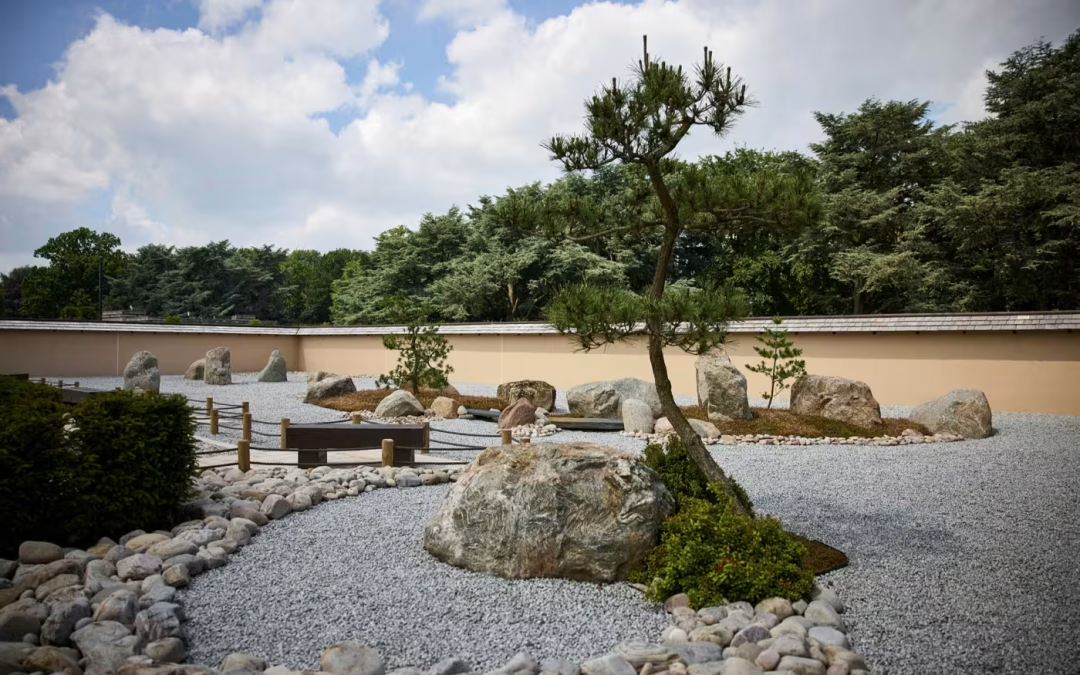
 

The Sky Was Never Disturbed: A Journey Through Doing, Being, and Non-Doing

The Sky Was Never Disturbed: A Journey Through Doing, Being, and Non-Doing

When I was a child in Mannarkkad, I remember seeing Krishnamurti books and audio tapes with Gopala thatha, a cousin of my grandfather. He had studied in Chennai and was deeply interested in Krishnamurti. During my teenage years, I considered myself an atheist and devoured the writings of rationalists like Dr. Kovoor. Meditation came much later—almost thirty years ago—after attending a talk by Swami Chinmayananda while I was searching for a job in Bangalore after graduation (or “non-graduation,” as I sometimes call it). What followed was a period of “window shopping”: at Wipro, then outside with TM, AOL, and Swami Sukhabodhananda. It was a kind of double life—on one hand, I was devouring Krishnamurti (both JK and UG) like a hungry wolf, and on the other, I was searching for meditation. Fortunately, the other streams dried up quickly—either I was kicked out, or I kicked them out. Much later, I found myself at a Vipassanā retreat in Igatpuri, thanks to Dr. Richard McHugh, who had introduced me (and Thara) to NLP. After several Vipassanā courses, including two Satipaṭṭhāna Sutta retreats, I quite serendipitously landed in Perumalmalai, in Zen, with Fr. AMA Samy.

This note is what I learnt mostly from Fr. AMA. Any errors could be my own limited understanding or misunderstanding. Credit wholeheartedly goes to Fr. AMA, my Zen Master, who took me into the Zendo as uchi deshi (live-in disciple).

Meditation, in its refined form, is one of the great gifts of the East to humanity. Across India, China, Japan, and Tibet, it was shaped into a precise discipline—a science of mind and consciousness. From the Buddha’s discovery of Vipassanā, to the Taoist harmonies of breath and spontaneity, to Zen’s radical simplicity of “just sitting,” and the luminous visions of Dzogchen and Mahāmudrā, the traditions converge on a single truth: awakening is not elsewhere, it is here.

When the Buddha sat beneath the Bodhi tree, he had already mastered the meditative techniques of his time. What he discovered was not merely stillness, but insight—the capacity to see impermanence, unsatisfactoriness, and non-self in every arising. This became the heart of vipassana, the disciplined work of cleansing perception. vipassana is like polishing a lens until it becomes clear. Each moment of mindful attention removes the dust of distraction, revealing the insubstantiality of all phenomena.

As the Dharma travelled east, it absorbed the Taoist sense of naturalness and spontaneity. In Zen, this blossomed into Zazen: a practice that does not rely on mantra or image, but on the radical simplicity of just sitting. Here, the mind is not forced into one-pointedness; it is invited to reveal itself. If vipassana is cleansing the lens, Zen is realizing that the lens and the light are not two. And in Shikantaza, one rests as the light itself.

Modern neuroscience helps us glimpse why these practices feel so different. Vipassana’s reframing strengthens the prefrontal cortex and calms the amygdala. Zazen’s concentration builds attentional networks and clarity. Shikantaza’s  acceptance reduces self-referential activity and loosens identification with thought. Reframing changes the story, concentration holds the lens steady, acceptance lets the sky be.

Zen thrives on paradox. Its manuals can run into hundreds of pages, yet the ultimate teaching is to transcend all manuals. Taoism says the Tao cannot be spoken, yet it offers the Tao Te Ching. Zen says enlightenment cannot be grasped, yet it offers koans and rituals. Both traditions use form to go beyond form, words to undo words, method to dissolve method. The way to non-dualism is through dualism. The way to the wordless is through words. Koans and chants are not ends in themselves but devices to exhaust the conceptual mind until it falls silent.

The culmination of Zen meditation is Shikantaza, “just sitting.” Here, even the intentionality of focusing on the breath is released. Awareness is open, unbound, choiceless. This resonates with Krishnamurti’s teaching of choiceless awareness: a seeing without interference of will or method. Tibetan traditions echo this spirit. Dzogchen rests in the natural luminous awareness. Mahāmudrā looks directly at the nature of mind. All point to the same ground: the uncontrived awareness that is always here.

Zen’s most radical affirmation is that samsara is nirvana. Awakening is not elsewhere—it is here, in this very body, in this very land. “This very body is Buddha, this very land is the Lotus Land.” Zen does not suppress desire but sees through it. It does not reject the world but awakens within it.

This is why, when we enter the Zendo, we bow—not to an external idol, but to ourselves, to the Buddha within. Sitting on the zabuton, walking in kinhin, working in samu, Zen reveals that daily life itself is meditation. Sweeping the floor, cooking rice, tending the garden—each is an expression of awakening.

Robert Pirsig captured this spirit in Zen and the Art of Motorcycle Maintenance. He suggested that Buddhahood resides in the gears of a motorcycle as much as in mountain peaks or lotus petals. To care for a machine with attention and reverence is no less an act of awakening than to sit in meditation. The sacred is not confined to temples or scriptures—it is found in the hum of an engine, the sweep of a broom, the breath in the belly.

The Ten Ox-Herding Pictures carry this teaching to its fruition. After searching for the ox, taming it, riding it, and finally forgetting it, the practitioner returns to the marketplace with open hands. The mountaintop represents emptiness and clarity; the marketplace represents form and daily life. The teaching is that emptiness and form are not two. True awakening is not escape but integration. The awakened one returns to the world of fish and toddy, mingling with people, laughing, working, living freely.

The path of meditation moves from doing to being, and finally to non-separation. Vipassanā represents the path of doing: the intentional, disciplined work of cleansing perception. Zazen represents the transition: using the form of posture and breath to settle into being. Shikantaza/Dzogchen/Mahāmudrā represent the culmination in non-doing: resting in the primordial awareness that was always present. Zen’s Radical Affirmation and the Ox-Herder’s Return represent the fruition: the realization of non-separation, where the absolute (nirvana, the mountaintop) and the relative (samsara, the marketplace) are seen as one inseparable reality.

The sky was never disturbed. In realizing this, we discover that meditation is not apart from life, but life itself—doing, being, and non-doing flowing into the freedom of non-separation. This is what I learnt, and continue to learn, from my teacher Fr. AMA Samy. To him I bow, to all teachers past, present, and yet to come, and to the ordinary life that, when seen with clear eyes, reveals itself as extraordinary.

The Crane That Could Not Lift and the Compassion Shift

The Crane That Could Not Lift and the Compassion Shift

Yesterday night, was on my way to Bangalore from Kanzeon Zendo, Perumalmalai. The KSRTC Volvo semi sleeper  bus stopped in the middle of nowhere. At first I thought , it was a momentary halt. But then as it lingered on  A, most of the passengers stepped down from the bus to look for the cause of block on the ghat road. I continued to read Mother Mary comes to me. Then Driver Krishnappa , came back and asked me to go and see. There was a mini truck off the road, almost landed perfectly on all four.

 Krishnappa, the ace KSRTC driver is one of my new found friends from my sojourn to  Perumalmalai over the last three years.  For the first two years, I had made a monthly trip of. Blr- Kodai- Blr  and since last December. It is. Kodai-Blr- Kodai.  Mostly on Sunday to Friday  or Friday to Sunday.  And most of these days, drivers were  Krishnappa, Girisha and  Sunmadhappa ….  I used to get down at Perumalmalai some 13 km away from Kodaikanal , the bus stand.  Though my initial interactions with them was just friendly courteous smiles and a thank you as I stepped off from the bus.  It was Krishnappa who broke the ice.  Once while having early morning coffee at that way side coffee shop during a pitstop, he asked me what I am doing at that place , making so may visits.  And when I shared about Zendo and Zen, he  told me with a hearty laugh, that they thought I am a drug carrier from Blr.  Especially since I used to travel lightly and used to get down before the check post and town limits.

From then onwards, those coffee became on the house for me. If Krishnappa was the driver,  he used to announce to them,  Nammavaru to the coffee “barrista”  which roughly translates. “ He is one of us”.

He was a very interesting character. One who took immense pride in being one of the really early Volvo bus drivers in Karnataka.  He told me that. It was Karnataka RTC which bought Volvo buses first in India and they  had put their best drivers for that fleet.  And I have heard that story from him quite a number of times.

So when a Pilot of an aero plane, a Captain of a ship and driver of your bus, tell you something, you think twice, or at times thrice before saying a  reason to say know. So I got down from the bus and made my way to that  accident spot. Just  10 – 20 meters ahead. 

 I was told, the driver had passed away on the spot. May be yesterday afternoon. Truck went down and the driver's soul up. Since the truck load was fruits, the owner had send a crane to lift the truck. Looking at the crane, Krishnappa told me that , that crane wont be able to life the truck with the fruit load. And after more than 1 1/2 hour of effort , those workers to agreed and gave up. On our walk back to bus, Krishnappa told me that many a times, driver die due to heart attacks. ANd accoding to him, that is a better way than live on with pain and severe injiruies. ! Neither i agreed nor disagreed with him. Our journey to Bangalore continued. MAy be that scene was playing up in my mind. When i landed in Bangalore home , very early morning, there in Linkedin popped up a advt brochure on Compassion Shift. An org i had worked ( ?) earlier is part of that program. and i had to type in the below comment. During the last part of my tenure over there, i was in deep depression. My otherwise friendly Tinnitus had turned into a monster in my brain and ate away, my sleep, my wakefulness, peace of mind, joy and hunger and tears. Dont know which crane was able to pull me out of that abyss. But i too landed on all four in Zendo on the Way. On reaching home, went with Thara for our breakfast at The Rameshwaram Cafe... Thara was talking about their new joint named Thirtha in Cunnigham road. May be there was too much butter on that crispy rava dosa. I slept again and woke up for lunch.. 🙂 Pls find below my comment without further comments. Shift / transformation is not a one time act . One constantly and consciously need to be aware and keep working on it. Often reflecting on the past does help. reflecting on the past is crucial. This is wise reflection (yoniso manasikara). We look back not with guilt or pride, but as a scientist studies data: · "In that moment of irritation, where was my compassion?" · "When I acted kindly, what was the true motive? Was it free from the 'passion' for gratitude or recognition?" · "How did that word or mindless act of mine land on the other person?" This reflection isn't dwelling; it's learning to do better next time. It's how we polish the lens of our understanding and make the "compassion shift" more accessible, more instantaneous, in the next moment of interaction. And what is a butcher’s compassion . Is it towards the animal or the knife as in Daoist parable of Cook Ding . And who are we in the parable! The animal, knife or Cook Ding ??? From someone who was on the receiving end of compassion…😀

On second thoughts,  I feel  compassion is not about choosing between the animal, the knife, or Cook Ding. it is about seeing that in each moment, we are all three—cutting, being cut, and learning to move with the grain of life. And in that realisation , the shift happens quietly without needing an external prompt, like a bus resuming its journey after a long halt on the ghat road. In the end, the truck stayed where it was, the crane gave up, and the bus rolled on. Life too moves like that—sometimes stuck, sometimes lifted, sometimes simply continuing. What matters is whether compassion travels with us. I don’t know which crane lifted me from my own abyss, or which hand steadied me when I landed on all four.

But I know this: each time I pause to reflect, compassion becomes a little more available, a little more natural. And that, perhaps, is the real shift.

Also the true crane is not outside us at all, but that  quiet strength, boot strap program written in us by that great intelligence  lifts us, again and again, into the next step of the Way.

Half‑Way Up the Mountain: Heights, Depths, and the Twilight Way

Half‑Way Up the Mountain: Heights, Depths, and the Twilight Way


John Moriarty  wrote in Dreamtime :

"It is like setting up a ladder against a rock wall by a lake. The lake mirrors your ascent as a descent. And so, thinking that I was ready for the Heights when I wasn’t simultaneously ready for the depths, that was my catastrophe, that was the avalanche I set off, looking ever upwards, on the Mount of Perfection. It carried me down into a Deep below all depths."

And C.G. Jung, put that in better psychological perspective :

"Nobody can fall so low unless he has a great depth. If such a thing can happen to a man, it challenges his best and highest on the other side; that is to say, this depth corresponds to a potential height, and the blackest darkness to a hidden light."

Two voices, two views— yet they meet in the same archetypal truth: the vertical axis of human experience is not one‑way. Every genuine ascent carries its shadow‑descent, and every plunge into darkness contains the seed of a corresponding light.

Mariana Kaplan, in her Halfway Up the Mountain  wrote of false claims to attainment. But the phrase reaches further than the problem of fake gurus and faker anti gurus and everyone else in between— it speaks to all of us. We are always, in some sense, halfway up the mountain. The summit is not a fixed point of eternal bliss, as some traditions promise. As we climb, the mountain itself rises.

The Greek philosopher Zeno hinted at this in his paradox: each time we move toward our goal, we can only cover half the remaining distance. Theoretically, we never arrive. The closer we get, the more the horizon recedes.

Buddhist teaching offers a similar lens: everything in this universe — you, me, the tree outside, the big rock near the Kanzeon Zendo waterfall, the distant mountain, the drifting clouds — is a process, not a finished product. There is no final arrival. The moment of arrival is already a moment of departure. In truth, we are always at the twilight of arriving and leaving, like the early morning and evening when sun and moon share the same sky.

And here, the metaphor meets the science: twilight is not when the Sun “shines most.” In fact, the Sun is below the horizon, its light reaching us only indirectly, scattered through the upper atmosphere. It is a softer, more diffused light — the “blue hour” photographers love — neither the full blaze of midday nor the darkness of night. This is why twilight is such a fitting image for the spiritual path: it is a time of transition, of partial illumination, of seeing enough to walk on, but never so much that all shadows vanish.

Many mistake spiritual progress for a straight, one‑way road. We imagine it as a steady climb, step after step, always forward. But the lived truth is far less linear. Sometimes it is one step forward, two steps back. Sometimes two steps forward, one step back. The rhythm is irregular, the pace unpredictable.

When we trudge toward the light, we do not leave the darkness behind; we carry it with us. The shadow is not an obstacle we “overcome” once and for all — it is a companion, a counterweight, a reminder. Light and shadow are not separate territories but a continuous spectrum, each shading into the other.

The movement is often like a pendulum swinging toward the light. But unlike a physical pendulum, the swing is not symmetric. The arc toward illumination may be long and slow, the return into shadow sudden and steep — or the reverse. The asymmetry is part of the work.

Dr. Kaustav Roy taught us phenomenology at APU, and one of the books he insisted we must read was R.D. Laing’s The Politics of Experience. That book held a distilled essence of human nature — a wisdom phrase to cherish in almost every paragraph. But one quote that stayed with me is:

“A good man is aware of what is not good in him, while a bad man is not.”

Awareness of the shadow is not a flaw in the journey; it is the journey. To see what is not yet whole in us is already to stand in the light. To deny it is to remain in darkness, even if our words and gestures point upward.

Moriarty’s mirrored ladder and Jung’s law of correspondence remind us that readiness for the heights is inseparable from readiness for the depths. To prepare for one without the other is to court collapse. The avalanche Moriarty speaks of is not a moral failure; it is the psyche’s way of restoring symmetry.

And so, halfway up the mountain is not a place of shame — it is the only place there is. The climb is endless, the summit ever‑rising, the path a dance between ascent and descent, light and shadow, arrival and departure. The measure of progress is not how far we have climbed, but how honestly we can stand in both light and darkness, in both coming and going, without losing our balance.

Perhaps this is why the old traditions speak of Great Doubt alongside Great Faith. The lake and the ladder, the light and the darkness, the ascent and the descent, the dawn and the dusk — they are not two journeys, but one.

In the end, the Way is not about reaching the top, nor about avoiding the fall. It is about walking with the mountain as it rises beneath our feet, with the lake reflecting both our ascent and our descent, with the twilight sky holding both sun and moon. Arrival and departure are the same step.

And in that step, the journey is complete — even as it begins again.


Chasing Cheese While Seeking Space: Are You the Last Rat in the Maze?

Chasing Cheese While Seeking Space: Are You the Last Rat in the Maze?

In the hush before dawn, the world is a maze without walls.
Some run, chasing the scent of cheese.
Some pause, listening for the sound of their own breath.
The path is the same, yet the journey is different.
Freedom is not in leaving the maze,
but in seeing it for what it is.

Kanzeon Zendo opened its doors on 22 December 2022. From January 2023 onwards, I began spending time here — thanks to my then boss, coach and mentor, Robert Meir. In those early months, my life was split evenly: fifteen days at the Zendo, fifteen days at home in Bengaluru. By December 2024, I had moved here fully, travelling back to Bengaluru for a week each month so I could be in the office for a day or two. Then, on 15 May, I left my job — or perhaps the job left me — and since then I’ve been here almost full‑time.

Through all these shifts, one refrain kept coming from friends, family, and coachees: “Good for you. At last you are out of the rat race.” At times I tried to explain that no one is truly free in this phenomenal life — the context and scenery may change, but in some way we are all still rats on the same ship. After being on the receiving end of a pay slip for some three decades, it is not easy to live with five or six thousand INR as your pension. Though, Fr AMA does provide me with the basic needs of life — food, shelter, medicines, and spiritual guidance. My words rarely landed. Yet the phrase “rat race” stuck with me. Why, I wondered, is the way modern humans live named after rats — of all animals?

I think, for more than a century, rats have been the quiet partners in our quest to understand ourselves. They are not just convenient lab animals; they are close cousins in biology and behaviour. Around ninety percent of our genes are the same. Their brains are built on the same blueprint as ours, with a cortex, hippocampus, and limbic system that process memory, learning, and emotion in ways strikingly similar to human minds. They live in social groups, form hierarchies, cooperate, compete, and even show empathy. They respond to stress, isolation, and reward much as we do. In the lab, they become mirrors — small enough to study, close enough to reveal truths about our own nature.

Perhaps that’s why rats have slipped so easily into our language as metaphors for human life. We talk about the “rat race” when we feel trapped in endless competition. We “smell a rat” when something feels off. A “pack rat” hoards possessions; to “rat on” someone is to betray them. We speak of “rats leaving a sinking ship” when people abandon a failing cause, and call ourselves “lab rats” when we feel like test subjects in someone else’s experiment. These phrases endure because they capture something raw and familiar: our instinct to survive, adapt, and sometimes, to scramble without asking why.

One story, often told in the spirit of B.F. Skinner’s work ( From Richard Bandler and John Grinder book "Frogs into Princes"), makes the point with a wry twist. Researchers trained rats to run a maze for cheese, and humans to run a scaled-up maze for five-dollar bills. Both learned quickly. Then the rewards were removed. The rats, after a few unrewarded runs, stopped. The humans kept going. Some even “broke in at night” to check if the money had returned. Whether or not this experiment happened exactly as told, the allegory is clear: we often persist in old patterns long after the reward is gone, driven by habit, sunk costs, or the hope that maybe this time will be different.

In the 1960s, ethologist John B. Calhoun built what he called Universe 25 — a rodent utopia with unlimited food, water, and nesting space. At first, the population boomed. But as crowd increased, social order broke down. Mothers neglected their young, aggression spiked, some withdrew entirely. Eventually, reproduction ceased and the colony collapsed. Calhoun called it the “behavioural sink” — a collapse of social functioning under crowding. It was a haunting image, and many took it as a warning about human cities. But density alone may not be the culprit. Bees live in extreme closeness — tens of thousands in a hive — yet thrive. Ants, termites,  elephants, wolves, dolphins  all live in tight social groups without imploding. The difference is that their societies are hard‑wired: every member has a defined role, communication is constant, numbers are regulated, and the survival of the group outweighs individual competition.

Humans are different. We are not locked into fixed roles by instinct. Our prefrontal cortex — the seat of planning, self‑control, and imagination — develops slowly over decades. This frees us from the tyranny of our genes, but it also means our social order is learned to a great extent and  not pre‑programmed. We can reinvent ourselves, but we can also lose our way. To thrive, we need to balance two deep drives: the need for space — physical, mental, psychological, and spiritual breathing room — and the need for cohesion — trust, belonging, and shared purpose.

Anthropologist Robin Dunbar’s research suggests we naturally organise into concentric layers, which we can think of as moving from core to tribe. At the centre is your core — about five people you can call at three in the morning, who know your fears, joys, and contradictions. Around them is your close circle of fifteen — the companions who show up when it matters. Beyond that is an affinity group of fifty — the people you’d invite to a big celebration, who know your story and whose stories you know. And finally, your tribe of about one hundred and fifty — the size of a functioning village, where faces are familiar and belonging is real. Beyond that, ties loosen and the emotional intensity fades.

Social media flattens these layers. It floods our inner circles with hundreds or thousands of weak ties, blurring boundaries and overloading our social brain. We end up with crowding without cohesion — a digital behavioural sink. The result can look eerily like Universe 25: withdrawal, aggression, or the emergence of “Beautiful Ones” who appear fine but are socially disengaged.

So, though “rat race” is most often used in the context of our workplaces — or the way we strive to hoard resources, both real and imagined, to secure a comfortable never‑ending, ‘immortal’ life for ourselves and those we love — it has quietly spread its wings into almost every sphere of our lives. This is, in part, because the layers of Dunbar’s circle have thinned, and the people we believe we love — or feel closest to — shift and change with surprising speed. All too often, our movement toward the inner circles, or our drift toward the outer ones, is shaped less by shared life and more by the fleeting currency of likes and applause within our social‑media cocoons. The compulsive, addictive,  reward-chasing behaviour, “RAT RACE”  isn't confined to our jobs; it has infected our social interactions, hobbies, and personal identities (via likes and applause) or even spiritual highways. Many are absolutely  blind to the sad reality that  their mindset can corrupt even their  quest for meaning and enlightenment.

Rats teach us about our instincts. Bees and elephants teach us about structure. Our own brains teach us about choice. The “rat race” isn’t inevitable — but escaping it means knowing when to run the maze, when to rest, and when to ask if the cheese was ever worth chasing. The maze is not the trap. The belief that the reward still exists — that is the trap. And perhaps the real question is not whether you are the last rat in the maze, but whether you still need to be in it at all.

Only when we see the rat race for what it is — a mousetrap in disguise — do we arrive at the real question. The question that really matters. And that question — not the answer — is our first and last step (infact only step) to freedom.

Skip to content