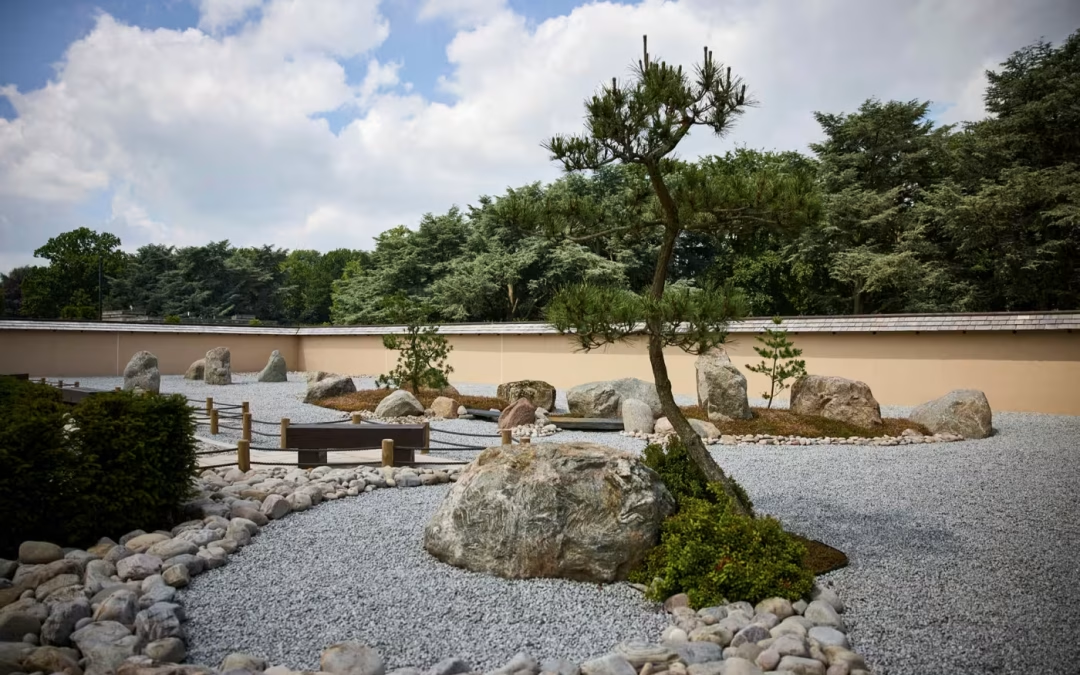
The Art of Living Well: Rehearsing Failure and Symbolic Death for a Successful Life

The Art of Living Well: Rehearsing Failure and Symbolic Death for a Successful Life

One of the best ways to set ourselves to success in any endeavour in life, is prepare ourselves the best for a potential failure. While it is true, with respect to skills, strengths and ability, it is better to strengthen our strengths than bridge the endless gap of lack of it. That does not work in the area of mindset and attitude.

How much ever we reframe ourselves with positive thinking and paper over those fears with hope, fear of failure, performance anxiety lies in some distant corner of our mind, like that potassium permanganate capsule. And the moment it gets burst in a beaker of water, it colours the water in no time. The same with that capsule of fear of failure / performance anxiety in the darkest recesses of our mind.

And only way we can purge it out of our system is, putting the 1000 lumens headlight of awareness right into it. All human transformations begin with awareness. In management parlance, there is a cycle of unconscious incompetence to unconscious competence. Unless we bring out what is there in our unconscious mind to the effervescent light of awareness, we will never be able to transform it.

This is where the ancient practices come alive. The way to do it is those Stoic exercises on death or Jesuit memento mori. While I learnt the Stoic exercise from the annual Stoic Week organised by University of Exeter, Fr. AMA taught me about the Jesuit practice of memento mori. Once we visualise what is the worst that can happen in our endeavour and then survive those torrid feelings in our body, it dissolves itself. The nervous system learns it has already “died” and returned. The capsule loses its potency. This is not just a mental reframing but a physiological release — the body itself learns freedom.

Athletes too have discovered this gate. Sports psychologists train competitors to rehearse failure — missed shots, falls, defeats — so that when the real contest arrives, the body does not recoil. The fear has already been faced. And Phil Jackson, the “Zen Master” of the Chicago Bulls, brought this wisdom to Michael Jordan, Scottie Pippen, and their teammates. He taught them meditation, breath awareness, and detachment from outcomes. In his method, the game was not just about winning but about presence. By rehearsing loss, by facing impermanence, the Bulls dissolved their fear and played with freedom.

I have been a student of spirituality and meditation for some 30+ years. And I did read quite a bit (in fact late Dr. Satish Inamdar, KFI Trustee and Director of The Valley School had said to me once, I will find my “way” when I stopped reading!) and did my quota of channel surfing and spiritual shopping in my life. And the search kind of ended while watching an NBA basketball match on TV in West Haven. Seeds of Zen were planted in my mind in the most unlikely of places. West Haven.

During June 1998. That was my first visit to the land of Baseball and Basketball. Both Greek and Latin games for me as a spectator. In the NBA final, Chicago Bulls were playing against Utah Jazz. What got my eye and attention was Chicago Bulls Coach Phil Jackson. There was an article in NYTimes that he used to make players like Dennis Rodman, who was an out and out rebellious, rule-breaking toughie, and Scottie Pippen and the larger-than-life Michael Jordan, all managed by the Zen Coach, Phil Jackson. I would have read and reread his book Sacred Hoops more than once. He was deeply spiritual with Native Indian and Zen philosophy. In fact, Jackson spent a large part of his life studying Buddhism and its principles, from his mentor Shunryu Suzuki. Jackson wrote, “What appealed to me about Zen practice was its inherent simplicity. It didn’t involve chanting mantras or visualizing complex images, as had other practices I’d tried. Zen is pragmatic, down-to-earth, and open to exploration. It doesn’t require you to subscribe to a certain set of principles or take anything on faith.”

Fourteen years later, in 2012, after my own experiments with truth and lies of spirituality, I did a hard landing into Bodhi Zendo and Zen, and real spiritual seeking started.

AMA Samy and Bodhi Zendo were different. I would compare Bodhi Zendo a bit with Esalen of Big Sur, CA. One of the most beautiful places of learning I had visited. It was not as regimented as a Vipassana session. It did allow a good amount of personal space to oneself. Sometimes a good conversation, a good joke and laughter at the dining table along with some yummy food, is as good as anything else in this world towards one’s spiritual seeking.

Secondly, AMA Samy had one of the best collections of books on spirituality, philosophy, theology and psychology I have seen in my life. (AMA seems to have read most of them.) When I was a full-time student of MA Education at APU Bangalore, I had to write a term paper on Phenomenology of Krishnamurti’s teachings as an assignment for Dr. Kaustav Roy. I was searching for a book of Heidegger at the Zendo library one December afternoon. AMA walked in to keep some book and he asked me what I was reading. When I explained to him my struggle with that phenomenology paper, he spent 15–20 minutes to sum it up for me like a précis. I ran back to my room, and jotted down in my notebook whatever I could remember. That assignment is one of the few for which I got an O grade. And getting it from Dr. Kaustav Roy was almost like a Fields Medal. 🙂

Thirdly and most importantly, no one demanded that the camel got to pass through the eye of needle test of Faith first and salvation later. The Kalama Sutta poster on the wall said it so succinctly: “Don’t blindly believe what I say. Don’t believe me because others convince you of my words. Don’t believe anything you see, read, or hear from others, whether of authority, religious teachers or texts.” And AMA Samy did practice it to every dot in the i and j and crosses in the t. Though he had a tough and rough demeanour as a Zen master, there was an endearing quality of integrity and compassion about the man. He took his spirituality and teaching seriously, not himself. That was absolutely refreshing to my tired seeking mind.

Even then, it took me 3 years to seek to be accepted as AMA’s Zen student. As the saying goes, once bitten twice shy and the cat which falls into a hot water tub will stay even from a cold water one. Heidi, a co-student of AMA in Japan with Yamada Roshi and later AMA’s student, spoke to me and asked me to join Bodhi Sangha.

And I did decide to seek to be accepted as a student of AMA Samy, after reading this passage in one of the books written by him:

“The master cannot give you satori; she/he is there to guide, to challenge, to test, to confirm. In truth, all the world is your teacher, the whole life of birth and death is the training field… Zen, therefore, is a teaching by negation, negating everything that the student supposes Zen to be, hoping that the student will realize that by not being any particular thing, s/he is everything; and that by not being any particular self, s/he is selflessly all selves.”

Coming back to our theme of this note: what emerges here is not just resilience, but antifragility — the capacity to grow stronger through stress and shocks. By rehearsing failure, we do not merely withstand adversity; we integrate it, and in doing so, we gain from it. The process unfolds as a living cycle:

Awareness → Acceptance → Integration → Freedom.

We move fear from the unconscious (where it controls us) to the conscious (where we can work with it). By mentally and emotionally surviving the worst-case scenario, we integrate the experience, and the capsule loses its potency. What remains is not naive hope, but a confident, grounded presence.

As the saying goes, hope for the best and prepare for the worst is the best strategy. Not pessimism, but resilience. In Zen terms, it is living with the certainty of impermanence while still planting seeds of joy and trust.


The Mist, The Lens, and AI: A Zen Guide to Clarity, Discernment, and Insight…

The Mist, The Lens, and AI: A Zen Guide to Clarity, Discernment, and Insight…

When I skipped a Zazen session to catch up on pending tasks, the mists and mountains seemed to come checking in. Instinctively, I tried to take a snap with my iPhone 16e.

“AI (Apple Intelligence) said: “Clean the camera lens.” 😀
AI is quite good. But Nature is a better product designer than humans. Any day, any time. 😀

It’s almost comic, isn’t it — AI urging you to “clean the lens,” while Nature is busy painting with fog, reminding us that clarity isn’t always the point. Sometimes the most truthful image is the one that hides as much as it shows.”

This share drew more responses than usual. One asked me whether Zen is anti‑tech.

I smile at the question. I’ve lived in technology for three decades. From IBM mainframes with TN3270 terminals and 5‑inch floppy diskettes, through Pascal, Fortran, COBOL, PL/1, C, minicomputers, HTML, XML, Java… I’ve seen the whole parade. Later, I spent another dozen years in Business Change Consulting. And if I look back honestly, much of what was called “transformation” was really just technology adoption masquerading as transformation. Tools changed, buzzwords changed, but the deeper work — how people think, decide, and act — was often left untouched.

What people miss is this: beneath every leap of technology, there was tremendous human endeavour. Nothing came out of thin air. Every so‑called revolution was built on the painstaking work of engineers, researchers, and practitioners who sweated through trial and error.

In those days, before CIOs became a fixture in organisations, users were cautious. Especially when it touched critical functions of human life. No beta versions, please. A few pioneers jumped into the cesspool of changes, but most waited for the defects and effects to surface and be rectified before adopting. There was always a gap — a chasm — between pioneers and early adopters.

And here’s another shift I’ve witnessed: in the early days, technology and industry were about designing and building products that lasted. My father wore a Favre Leuba watch for over 40 years. It worked wonderfully. Newspapers carried stories of Toyota Corollas or Mercedes Benz cars clocking 200,000 km with ease. Durability was a mark of pride.

But somewhere along the way, in the greed of economics, the philosophy changed. Planned obsolescence became the model. Phones that slow down after a few years, software that forces upgrades, cars that are more electronics than engines. The cycle of consumption sped up, and with it came the illusion of progress.

And yet, not all change is regress. Some changes are truly good. They add value to us — individually and collectively. The core question is whether those changes are tested, evaluated, and implemented in such a way that they can be called progress for all, rather than just swelling the bank balances of a few.

Later, when I went back to APU for a full‑time postgraduate course in Education, I took a class on Education Technology. A professor from Finland told us how, after the initial euphoria, Nordic countries were returning to more traditional schooling. She reminded us of Steve Jobs’ own words: when asked if his children loved the iPad, he said, “They haven’t used it. We limit how much technology our kids use at home.” The paradox is striking: the creator of the iPad preferred his children to rely on books, conversation, and presence. The Nordics, too, discovered that tools are useful, but they cannot replace the atmosphere of learning.

This is not new. Back in 1962, Everett Rogers, a rural sociologist, studied how farmers adopted hybrid corn. He noticed adoption followed a predictable curve: innovators, early adopters, early majority, late majority, laggards. That became the Technology Adoption Life Cycle. Decades later, Geoffrey Moore — once an English professor — reframed it in Crossing the Chasm. He saw that between early adopters and the early majority there is a dangerous gap. Not because people are too skeptical or cautious, but because visionaries and pragmatists live by different values. The chasm is not resistance. It is a threshold.

And now, AI. A wonderful tool, the culmination of work on neural networks since the 1940s. But some of the claims I read today are extraordinary... Many forget that AI is, at its core, another computer program written by humans.

AI can simulate conversation, generate images, even mimic reasoning. But simulation is not embodiment. AI does not live in a body, carry memory in the marrow, or transmit atmosphere through silence. To confuse fluency with wisdom is to mistake the mist for a dirty lens.

We must remember: AI is not born but made. Its "intelligence" is painstakingly sculpted through training, and its wisdom is fundamentally bounded by the quality and scope of that original dataset. This boundedness is by design—a necessary guardrail, as seen with early systems like Tay, to prevent misuse.

This reveals the chasm between artificial training and human nurture. An AI operates as a closed system; its knowledge is a snapshot, frozen in time, with interactions kept in transactional isolation. Human wisdom, in contrast, is an open system, unbounded by life itself. We learn through wilful, integrated synthesis—constantly connecting conversations, emotions, and experiences in a messy, living tapestry of understanding.

This is why AI, for all its power, cannot be truly spiritual or social. These realms require the very integration and embodied context that its architecture prevents.

And hype is not confined to AI. Remember Theranos? Genny Harrison, who worked in Silicon Valley, wrote of how executives around her canonized Elizabeth Holmes while dismissing questions about functionality. “It was faith disguised as innovation,” she wrote. “The black turtleneck became a costume for credibility. The TED Talk tone replaced evidence. It was never about blood testing. It was about belief.”

Holmes knew exactly what she was doing. By donning the black turtleneck, she borrowed the aura of Steve Jobs, hoping to cloak herself in his myth of genius and inevitability. It was a prop, a costume, a calculated illusion. And it worked — until it didn’t.

Theranos collapsed, but the machinery that made it possible never stopped. Every few months another founder emerges with the same manic optimism and the same empty promises, and we fall for it again.

Zen is not anti‑tech. It is anti‑illusion. The mist on the zendo lens is not a flaw but a teaching. The Theranos story is not an exception but a mirror. The chasm is not skepticism — it is the threshold between vision and proof. And AI, too, is not magic. It is a tool, and its claims must be tested, not worshipped. Education reminds us: atmosphere, presence, discernment matter more than devices.

Zen also teaches us to be in touch with reality. The Buddha, in the Kalama Sutta, urged: “Do not go by reports, by legends, by traditions, by scripture… but when you know for yourselves that these things are wholesome and lead to welfare, then you should practice them.” For Zen practitioners, great faith is always balanced by great doubt. Faith without doubt becomes blind belief; doubt without faith becomes cynicism. Together, they keep us alive to reality.

And Zen warns of makyō — the delusions that arise in meditation, dazzling visions that can seduce us away from truth. But makyō is not confined to the cushion. In the tech world, hype cycles, inflated valuations, and charismatic founders are also forms of makyō. They dazzle, but they are not reality.

From Rogers’ cornfields to Moore’s chasm, from mainframes and floppy disks to AI’s extraordinary claims, from Nordic classrooms back to chalkboards, from the black turtleneck of Theranos to the mist‑covered zendo, and from watches and cars built to last to systems endlessly swapped between Oracle and SAP — the real adoption curve is not about technology at all.

It is about learning to see through illusion, to honor the human endeavour beneath every leap, and to return, again and again, to reality.

I am not a tech hater. I appreciate the extraordinary things AI can do. But discernment matters. Not every wave is worth riding. Progress is not measured by the speed of adoption, but by whether it truly serves human well‑being.

In this era of overhype, it is important to be a conscious practitioner and an aware user. When many confuse simulation for substance, caution is not undue fear but wisdom. Asking “how” and “why” before jumping into the cesspool of “what next” is the only antidote to cynicism and hype.

Questioning is not cynicism. It is clarity.

In recent times, many extraordinary claims have been made by persons of repute. But as Carl Sagan wisely reminded us: ‘Extraordinary claims require extraordinary evidence.’

AI is neither Frankenstein’s monster, as some fear, nor a divine panacea, as some hope. It is not apocalypse, nor salvation. Like the wheel, fire, or even sliced bread, it is simply another invention — extraordinary, yes, but still human-made. It is a tool — perhaps as consequential as the wheel, fire, or sliced bread — but still a tool, shaped by human hands and human choices. One should never forget the fact that AI is another computer program... Maybe a much better one. Still a computer program.

And the most important founding principle of computers and programs remains unchanged: GIGO — Garbage In, Garbage Out. However advanced the system, it cannot rise above the quality of its inputs. Only the human mind can discern, in the living moment, what is garbage and what is not.

And so, the mist returns. The zendo lens fogged not to obscure, but to remind: clarity is not always the point. Illusion is not always error — sometimes it is teaching. Technology, like mist, can veil or reveal. The task is not to worship the fog or the lens, but to see through both, to discern what truly serves life.

In the end, Zen is not anti‑tech. It is anti‑illusion. The mountains in mist, the black turtleneck of Theranos, the hype cycles of AI — all are invitations to look again. To pause. To test. To return, again and again, to reality.

P.S. I ran this past Copilot, my partner‑in‑crime, and even from an AI perspective my apprehensions seem valid. While it is important to use a tool, it is equally important not to be used by a Tool.

Vanaprastha for Our Times: On Burnout, Busyness, and the Third Path

Vanaprastha for Our Times: On Burnout, Busyness, and the Third Path

When M@@@@Lee first arrived at our zendo, I was struck by his quiet discipline. Middle‑aged, yet carrying the vitality of someone twenty years younger, he never missed a single zazen session. He spoke little, preferring to rest his gaze on forests, hills, and waterfalls rather than books. Only later did I learn of his past: 18 years in the United States as a chartered accountant, often working eighteen‑hour days in investment banks, living in luxury until burnout forced a reckoning.

For the last One and half decades, he has lived like a nomad, frugal and free. He speaks of happiness and contentment not as achievements, but as discoveries. His story is a living commentary on Byung‑Chul Han’s The Burnout Society. Han, another son of Korea, describes how the achievement society—with its relentless drive to optimize, perform, and succeed—leads not to freedom but to exhaustion. He contrasts deep attention, the contemplative focus that gave rise to philosophy and art, with hyperattention, the restless scattering of the mind across endless stimuli. In losing boredom and silence, Han warns, we lose the very conditions for renewal.

Lee embodies the medicine Han prescribes. His burnout was the breaking point Han diagnoses. His nomadic simplicity is the refusal of the achievement society. His steady zazen restores the deep attention Han says we have lost. His gaze on forests and waterfalls is a return to what Han calls the contemplative dwelling that modernity has abandoned.

And then there is Gopal, a respected corporate leader who recently reflected on his own transition into retirement. Quoting his father, he wrote: “To catch a train that has already started, you may have to run alongside it before jumping in.” It is a wise metaphor for transitions, yet it also reveals the subtle compulsion many of us feel—to keep running, to keep filling life with activity, even when the train we are chasing may not be ours to board.

In observing these two paths—Lee's and Gopal's—we see a fundamental dichotomy in how we face life's transitions. On one end lies the person who is totally burnt out... On the other, the person who, even after a great innings...

So it is safe to assume there are two kinds of people out there. The exhausted renouncer and the restless achiever. One who feels totally burnt out and want nothing to do with it. For him, emptying his mind about anything about it is what makes the rest of his life worthwhile. While the other, after a great innings and having done brilliantly well in his chosen profession, still is eager to jump into the next train of achievement. After reaching the top of the pyramid, why the eagerness, why the worry about the next phase of productivity? Monetary considerations of worry about a lesser lifestyle may not be the reasons. If one is intended to use their great expertise and knowledge of serving the mankind for the rest of their life after a great fist innings, may not get that wary about what s/he will be doing with their time. Being not comfortable about not being in limelight, could be one. Or maybe it is due to the worry about how to be with the void /emptiness in their life.

Even if  they worry about the next innings for none of the above mentioned reasons and it is just for timepass, when we call it timepass—scrolling reels, flipping channels, or filling the calendar with trivialities—it is rarely innocent. Beneath the surface lies the same movement: the fear of the void.

We are uneasy with silence, with the space where applause fades and identity loosens. So we keep ourselves busy, not because the activity nourishes us, but because it shields us from emptiness.

But as Krishnamurti reminds us, emptiness is not a defect to be patched over. It is a doorway. When we stop trying to fill it, the void reveals itself as fullness—alive with creativity, compassion, and presence.

The real courage is not in passing time, but in letting time pass through us, unresisted.

Here, Pascal’s old warning rings true: “All of humanity’s problems stem from man’s inability to sit quietly in a room alone.” Whether it is the youth endlessly scrolling through reels, the middle‑ager flipping through channels, or the retiree rushing to fill the calendar, the root is the same: our discomfort with stillness.

Krishnamurti went even deeper. He observed that as long as the mind is seeking to fill its emptiness, it will remain empty. We try to fill the void with activity, possessions, relationships, or applause, but this only perpetuates the sense of lack. He wrote: “As long as the mind is seeking to fill itself, it will always be empty. When the mind is no longer concerned with filling its own emptiness, then only does that emptiness cease to be.”

For Krishnamurti, emptiness is not a defect to be patched over, but a doorway. “In emptiness alone can there be creation,” he said. When the mind stops running, stops filling, stops chasing trains, it discovers a silence that is not absence but presence. From that silence, something new can be born—innocence, creativity, compassion.

This is the crucial distinction:

  • To fill hunger is natural, necessary, life‑sustaining.
  • To fill psychological emptiness is endless, and often destructive.

When activity arises from genuine need or from the joy of service, it nourishes. When it arises from fear of silence or the craving for applause, it drains.

Zen would call this the great death of the striving self. And in that death, a new life appears—one that needs little, yet feels complete.

In the ancient Indian worldview, Vānaprastha—the stage of “going to the forest”—was not only for ordinary householders but also for kings and emperors, who were expected to renounce power and wealth at their peak and turn toward contemplation. King Bharata, after whom Bhārat (India) is named, is one of the most striking examples: he gave up his throne and retreated into the forest to seek liberation.

Today, the forest may not be a literal place, but a state of mind—an inner withdrawal from applause and limelight into presence.

Between the exhausted renouncer and the restless achiever, there are a few rare ones who discover meaning early and live it seamlessly until their last breath. For them, life is not about applause or limelight, nor about withdrawal in exhaustion. Their work itself is their prayer, their service, their offering.

Saba Naqvi once wrote of Mallikarjun Mansur, the saintly Hindustani vocalist from Dharwar. Stricken with lung cancer, doctors had given up. His daughter was told not to deny him the things he loved most. In his final moments, he asked for a bidi, and as he drew on it, he was still humming Raga Jogiya, almost inaudibly. With the raga on his lips, his head rolled over, and he was gone. His art was his final breath.

Another story is told of Abdul Karim Khan, founder of the Kirana gharana. On his way to Puducherry to sing for Sri Aurobindo, he sensed his end was near. He stepped off the train at an unknown station, spread out his prayer mat, and sang his last song. He died there on the platform. He did not board the next train of achievement—he stepped off, to let music itself carry him across.

And I see the same spirit in my own Zen master, Fr. AMA Samy. At ninety, he still sends emails at 3:30 a.m. with reflections, still walks into the zendo for early morning meditation. His life is not about filling time or clinging to relevance. It is about continuity of presence, a rhythm of practice that does not retire.

These lives remind us that there is a third path: not renunciation in exhaustion, not striving for the next platform, but a life so deeply rooted in one’s calling that even the final breath is an act of practice, art, or service. For them, there is only one train—the train to eternity.

In the end, whether we are young and restless, middle‑aged and distracted, or retired and still wary of leaving the limelight, the invitation is the same: to stop running, to stop filling, to sit still. The rishis called it Vānaprastha. Han calls it deep attention. Pascal calls it the courage to sit quietly. Krishnamurti calls it the doorway of emptiness. Zen calls it the great death of the striving self. Many names, one truth: the train we most need to catch is not out there on the tracks—it is already here, in the stillness of this very moment.

The Crane That Could Not Lift and the Compassion Shift

The Crane That Could Not Lift and the Compassion Shift

Yesterday night, was on my way to Bangalore from Kanzeon Zendo, Perumalmalai. The KSRTC Volvo semi sleeper  bus stopped in the middle of nowhere. At first I thought , it was a momentary halt. But then as it lingered on  A, most of the passengers stepped down from the bus to look for the cause of block on the ghat road. I continued to read Mother Mary comes to me. Then Driver Krishnappa , came back and asked me to go and see. There was a mini truck off the road, almost landed perfectly on all four.

 Krishnappa, the ace KSRTC driver is one of my new found friends from my sojourn to  Perumalmalai over the last three years.  For the first two years, I had made a monthly trip of. Blr- Kodai- Blr  and since last December. It is. Kodai-Blr- Kodai.  Mostly on Sunday to Friday  or Friday to Sunday.  And most of these days, drivers were  Krishnappa, Girisha and  Sunmadhappa ….  I used to get down at Perumalmalai some 13 km away from Kodaikanal , the bus stand.  Though my initial interactions with them was just friendly courteous smiles and a thank you as I stepped off from the bus.  It was Krishnappa who broke the ice.  Once while having early morning coffee at that way side coffee shop during a pitstop, he asked me what I am doing at that place , making so may visits.  And when I shared about Zendo and Zen, he  told me with a hearty laugh, that they thought I am a drug carrier from Blr.  Especially since I used to travel lightly and used to get down before the check post and town limits.

From then onwards, those coffee became on the house for me. If Krishnappa was the driver,  he used to announce to them,  Nammavaru to the coffee “barrista”  which roughly translates. “ He is one of us”.

He was a very interesting character. One who took immense pride in being one of the really early Volvo bus drivers in Karnataka.  He told me that. It was Karnataka RTC which bought Volvo buses first in India and they  had put their best drivers for that fleet.  And I have heard that story from him quite a number of times.

So when a Pilot of an aero plane, a Captain of a ship and driver of your bus, tell you something, you think twice, or at times thrice before saying a  reason to say know. So I got down from the bus and made my way to that  accident spot. Just  10 – 20 meters ahead. 

 I was told, the driver had passed away on the spot. May be yesterday afternoon. Truck went down and the driver's soul up. Since the truck load was fruits, the owner had send a crane to lift the truck. Looking at the crane, Krishnappa told me that , that crane wont be able to life the truck with the fruit load. And after more than 1 1/2 hour of effort , those workers to agreed and gave up. On our walk back to bus, Krishnappa told me that many a times, driver die due to heart attacks. ANd accoding to him, that is a better way than live on with pain and severe injiruies. ! Neither i agreed nor disagreed with him. Our journey to Bangalore continued. MAy be that scene was playing up in my mind. When i landed in Bangalore home , very early morning, there in Linkedin popped up a advt brochure on Compassion Shift. An org i had worked ( ?) earlier is part of that program. and i had to type in the below comment. During the last part of my tenure over there, i was in deep depression. My otherwise friendly Tinnitus had turned into a monster in my brain and ate away, my sleep, my wakefulness, peace of mind, joy and hunger and tears. Dont know which crane was able to pull me out of that abyss. But i too landed on all four in Zendo on the Way. On reaching home, went with Thara for our breakfast at The Rameshwaram Cafe... Thara was talking about their new joint named Thirtha in Cunnigham road. May be there was too much butter on that crispy rava dosa. I slept again and woke up for lunch.. 🙂 Pls find below my comment without further comments. Shift / transformation is not a one time act . One constantly and consciously need to be aware and keep working on it. Often reflecting on the past does help. reflecting on the past is crucial. This is wise reflection (yoniso manasikara). We look back not with guilt or pride, but as a scientist studies data: · "In that moment of irritation, where was my compassion?" · "When I acted kindly, what was the true motive? Was it free from the 'passion' for gratitude or recognition?" · "How did that word or mindless act of mine land on the other person?" This reflection isn't dwelling; it's learning to do better next time. It's how we polish the lens of our understanding and make the "compassion shift" more accessible, more instantaneous, in the next moment of interaction. And what is a butcher’s compassion . Is it towards the animal or the knife as in Daoist parable of Cook Ding . And who are we in the parable! The animal, knife or Cook Ding ??? From someone who was on the receiving end of compassion…😀

On second thoughts,  I feel  compassion is not about choosing between the animal, the knife, or Cook Ding. it is about seeing that in each moment, we are all three—cutting, being cut, and learning to move with the grain of life. And in that realisation , the shift happens quietly without needing an external prompt, like a bus resuming its journey after a long halt on the ghat road. In the end, the truck stayed where it was, the crane gave up, and the bus rolled on. Life too moves like that—sometimes stuck, sometimes lifted, sometimes simply continuing. What matters is whether compassion travels with us. I don’t know which crane lifted me from my own abyss, or which hand steadied me when I landed on all four.

But I know this: each time I pause to reflect, compassion becomes a little more available, a little more natural. And that, perhaps, is the real shift.

Also the true crane is not outside us at all, but that  quiet strength, boot strap program written in us by that great intelligence  lifts us, again and again, into the next step of the Way.

Adventures of a Bystander in the Age of AI — Crossing the Chasm Within

Adventures of a Bystander in the Age of AI — Crossing the Chasm Within

Everyone is talking about AI taking away jobs. Just a few days back, a Coaching colleague, whose practice focus in Career shifts  wrote a wonderful passage that  the bigger issue may not be unemployment—it is meaninglessness. “Work has never been just about money. It has been about identity. It provides structure. It is the story our parents proudly share when someone asks about us. Take that away, and who are we? The fear of meaninglessness is real. For many, work has been the anchor of identity, the rhythm of daily life, and the narrative thread of belonging. AI disruption threatens to unsettle that anchor. It is not just about automation or efficiency; it is about the erosion of the stories we tell ourselves and others about who we are.”

And yet, this is not inevitable. History shows a recurring pattern: when technology reshapes work—whether in the industrial revolution or the digital revolution—humans eventually re-anchor meaning in new roles, crafts, and communities. The challenge is not the disappearance of meaning, but the transition, the liminal space where old identities dissolve before new ones take shape. I know this from experience. For over fifteen years, I worked as a Change and Transformation consultant. Then one day, I stopped. Not because the work was meaningless, but because I no longer needed that identity to define me. I discovered that life continues, and meaning can be found in other places—relationships, writing, contemplative practice, service. The pay check was never the whole story.

Peter Drucker was introduced to me by none other than Subroto Bagchi, who wrote quote often about him.  Subroto considered   Drucker as the father of modern management. By the way, while many other management gurus are known by the great institutions they are affiliated with, Drucker chose a low key University and eventually that institution got its identity from  Drucker’s contribution to the Management science.

Drucker began his career in an apprenticeship at a Hamburg trading company. By his own account, he “learned nothing” about the business itself—the managers barely paid attention to the trainees. Yet he later said it was not a wasted year. He read voraciously, discovered Kierkegaard, and began shaping the philosophical foundations that would define his life’s work. Apprenticeship, he showed, is not only about acquiring skills, but about forming identity through exposure, discipline, and reflection. In times of disruption, perhaps we are all apprentices again—learning to re-anchor meaning in unexpected places.

Drucker’s memoir, a classic must read,  Adventures of a Bystander, makes this even clearer. He portrays himself not as a man defined by his jobs, but as an observer, a learner, a bystander to history. His identity was never confined to the roles he held—consultant, professor, writer—but was rooted in curiosity, reflection, and the people and ideas he encountered. His life shows that one can live fully, contribute deeply, and yet not be imprisoned by professional labels.

He also recounted a disturbing episode from his time in a London investment bank in the 1930s. What struck him was not the technical work of finance, but the culture of the firm—how traditions, rituals, and unspoken rules shaped identity and power. Among these, Drucker noted a shocking practice: the secretary of the managing partner was considered part of the “succession package.” Whoever was to become the next managing partner was expected to assume not only the professional responsibilities of the role but also inherit the secretary in a personal capacity. Drucker was appalled by this, and he shared it as an example of how institutions can normalize practices that, when seen from the outside, are clearly unethical and dehumanizing. The point of the story is not the scandal itself, but the lesson Drucker drew: organizations often bind identity to roles in ways that are arbitrary, unhealthy, or even absurd. What was considered “normal” in that investment bank was, in fact, a distortion of both work and human dignity. Drucker’s lifelong insistence that management is a moral practice—not just a technical one—was shaped by witnessing such episodes early in his career.

Hannah Arendt, some 70 years ago, predicted the peril of modern life—long before the so‑called knowledge economy came into existence—that chasing productivity would extinguish meaning. In her seminal groundbreaking work, The Human Condition, she distinguished between labour, the endless cycle of necessity tied to survival; work, the creation of durable things that give the world stability; and action, the highest form of freedom, where we reveal ourselves to others and shape history. Her concern was that modernity collapses these distinctions, reducing all activity to the logic of labour and output. In such a world, thought is measured by its utility, people are valued by their efficiency, and even leisure is instrumentalized as recovery for further work. This marks the triumph of the animal laborans—the human as labouring animal, hollowing out meaning and eroding the very spaces where freedom, creativity, and genuine human action can arise.

One of the most influential books on technological change, Crossing the Chasm, was written not by an engineer but by an English Literature professor, Geoffrey Moore. That paradox is telling: the deepest insights about change often come from outside the expected domain. They remind us that identity is larger than occupation, and that wisdom often comes from the margins. So the deeper question is not “What will AI take away?” but “Who am I when the titles and roles fall away?” One of the most powerful coaching questions I have ever faced was exactly this: define yourself beyond titles, beyond roles. Interestingly, that question did not come from a certified coach, but it has stayed with me as one of the most transformative. It stripped away the masks and left me face-to-face with something more essential.

I am also reminded of a story shared by Wipro veteran Dr. Sridhar Mitta. In the early days, Wipro manufactured PCs and even built a homegrown productivity suite. When these systems were installed in offices, the Munims of Kolkata—masters of the traditional Marwari accounting system, Parta—insisted on cross-checking the computer’s output with their own methods. They did not trust the machine. Change takes time. But eventually, they adapted. And so did the organizations around them. This story is a parable: humans resist, test, and cross-check—but eventually, we learn to swim in new waters.

Fish know how to swim. Squirrels know how to climb trees. And birds know how to fly. They did not need finishing schools or certified coaches. The only inherent talent humans are born with is the ability to adapt—and to work with strangers. Unlike other animals, we are wired for collaboration and reinvention. That is our evolutionary gift. AI may unsettle our roles, but it cannot erase this gift. If anything, it calls us to exercise it more consciously.

But there is another way to meet disruption—not by clinging to new roles, but by letting go  the shackles of identity itself. After moving out of the 9–5 prison of corporate walls, paychecks, and social media emojis, I immersed myself in the ordinary life of a Zen student, guided by an ordinary Zen teacher, in an ordinary Zendo. And in that ordinariness, something extraordinary revealed itself. I began to notice that I was no longer the protagonist of my life, endlessly striving to perform and prove. More often, I was simply a witness. Watching thoughts rise and fall. Watching the Zendo waterfall come alive and then dry itself out. Learning to be calm under stress from Zendog Bhim . Watching myself breathe. When one shifts from being the protagonist—the doer, the achiever—to being the witness—the observer—a spaciousness opens that can hold all of life’s experiences without being defined by them. In this shift from doing to witnessing, my equanimity, inner peace, tranquillity, and joy have not just grown—they have multiplied. And one thing I reaslised is in that state of mind, Arendt’s definition of  Labour becomes an action from the true mind. Infact Zen, through its ordinary life, ordinary mind  just teaches this.  Everything is selfless action. Whether it is archery, ikkenaba, cleaning dishes or zendo, walking dog, reading philosophy or doing zazen.

So in my humble view, the real answer to the problem of meaninglessness is not to seek new identities, new labels, or new masks. That is only rearranging the furniture in the same prison cell. The deeper work is to strip away those onion skins of identity—consultant, professional, achiever, even seeker—until what remains is the emptiness at the core. And in that emptiness, there is no void. There is space. Spaciousness that holds everything: joy and sorrow, gain and loss, sound and silence. As the Heart Sutra reminds us: form is emptiness, emptiness is form. To realize this is to be free—not from work or responsibility, but from the compulsion to define ourselves by them.

AI may strip away the masks we have worn at the market place for decades. But perhaps this is not a loss—it is an invitation. An invitation to rediscover meaning in relationships, creativity, service, and contemplative practice. An invitation to remember that identity is not a title on a business card, but the living presence we bring to each moment. Identity can be adaptive, distorted, or transcended—but never reduced to a job title. The Munims of Kolkata, Drucker the bystander, Arendt the philosopher, Moore the literature professor, the London banker’s secretary, and the Zen student in the ordinary Zendo all point to the same truth: we are more than our roles. And when the roles fall away, what remains is the freedom to simply be. What remains for you, when the roles fall away?

It feels fitting to conclude with a final layer of witness-consciousness. This essay itself is a product of the very transition it describes. The thoughts, experiences, and conclusions are my own, but the process of articulating them was a collaboration with an AI language model. It served as a digital apprentice, helping to structure arguments and find connections between Drucker, Arendt, and Zen. In this collaboration, I experienced the very point I hoped to make: the tool did not define the meaning; it aided in its expression. The witness—the essential self—remained, simply using a new kind of brush to paint its truth.

When the race ends, the path begins with the myth that is yours…

When the race ends, the path begins with the myth that is yours…

When Bill Moyers asked Joseph Campbell what someone in a midlife crisis should do if they had lost their way, Campbell’s answer was deceptively simple:

“Follow your bliss, and if you follow your bliss, doors will open where there were no doors before.”

It is a phrase that has been quoted endlessly, often mistaken for a call to chase pleasure or excitement. But Campbell was pointing toward something far deeper — the kind of joy the Sanskrit word ananda evokes, a quiet, abiding sense of rightness that arises when we are in harmony with our true nature.

This bliss is not something we manufacture; it is already here, like the sun behind clouds. Most of the time, the mind is noisy — restless commentary, anxious planning, comparisons, compulsions. In that noise, bliss is not destroyed, only hidden.

When the mind grows still, even for a moment, the clouds part and the light is revealed. Campbell himself warned that if your “bliss” is just excitement or fun, you are on the wrong track; you must come down to a deep place in yourself, a place beyond the surface ripples of mood and circumstance.

I started reading Joseph Campbell after a chance whistle‑stop visit to Giza near Cairo. The Power of Myth and The Hero with a Thousand Faces are must‑reads.

Often, you realise your bliss not when you go after it, but when life seems to have thrown you out of the race entirely. You reach a dead end. You feel like a failure on all counts, and the thought of living feels heavier than the thought of dying.

And then, something happens deep inside. Something flips. You look straight into the eyes of what you had feared most, and instead of turning back, you step into it. You immerse yourself in the very thing you once resisted.

From that moment, public applause, acceptance, bank balance, readership, mindshare, likes and emojis — none of it matters anymore. You don’t want to be a groom in every wedding and a corpse in every funeral. Being anonymous is equal to being famous.

And strangely, after that turning and churning, even those dearest to you begin to align with your life in ways you could never have orchestrated.

My better half, Thara, told me when Fr. AMA asked me to join Kanzeon Zendo as his assistant, that a calling is different from a job, a career or a profession. When you are called by life, you go with it. And I did just that.

In our time, the idea of bliss has been reinterpreted in many ways. Some see it as living in alignment with one’s deepest values, others as the contentment that comes from mindfulness and presence. Neuroscience and positive psychology frame it as a trainable state, cultivated through meditation, gratitude, and compassion.

In a world of constant stimulation, bliss can also mean mental spaciousness — the relief of being free from endless distraction. For creatives and athletes, it can resemble the flow state, where self-consciousness drops away and time feels fluid.

Across these interpretations, the thread is the same: bliss is less about acquiring something new and more about uncovering what has always been here.

Campbell often reminded us that we all live within myths, whether we recognise them or not. Some myths confine us, keeping us circling in patterns that feel safe but small. Others guide us toward the deep place where bliss resides.

To follow your bliss is to follow the myth that is truly yours — the one that opens doors you never knew were there, not because the world has changed, but because you have. And when the noise quiets, you may find that the path was here all along, waiting for you to walk it.

As the Spanish poet Antonio Machado wrote:

Caminante, son tus huellas el camino y nada más;
Caminante, no hay camino, se hace camino al andar.
Al andar se hace el camino, y al volver la vista atrás
se ve la senda que nunca se ha de volver a pisar.
Caminante, no hay camino sino estelas en la mar.

Wayfarer, your footprints are the only road, nothing else.
Wayfarer, there is no road; you make your own path as you walk.
As you walk, you make your own road, and when you look back
you see the path you will never travel again.
Wayfarer, there is no road; only a ship’s wake on the sea.

Skip to content